
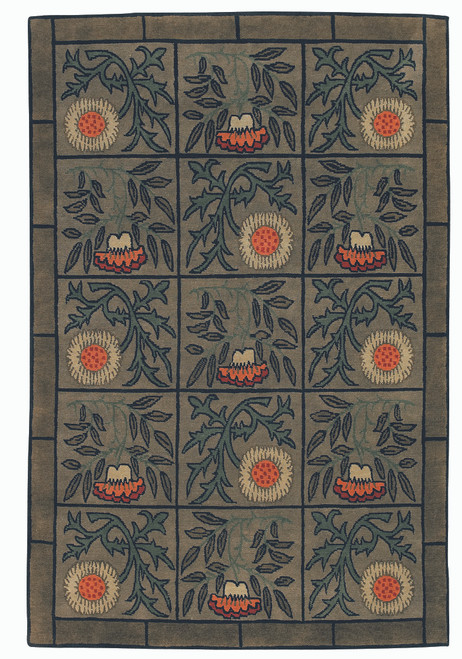
Hand-Knotted Rugs vs Tufted Rugs: Which Build Fits Your Home
Posted by Mission Motif on Jul 18th 2026
In a room with quarter-sawn oak floors and hand-finished woodwork, the rug you place will either honor that craftsmanship or quietly undermine it. The difference between hand-knotted and hand-tufted rugs is not a matter of branding or pattern.
It is a difference in how the pile is physically built, what holds it in place, and how many years the rug can serve before the fibers loosen or the backing fails.
For over 20 years, Atlanta homeowners have paired handmade area rugs with Arts and Crafts interiors. The clearest guidance comes from specialists who know both rug craftsmanship and the full Stickley collection.
That kind of experience makes the construction differences between knotted and tufted rugs a daily showroom conversation, not an abstract comparison.
Keep reading to learn exactly how each rug type is constructed, where their durability paths diverge, and which build suits each room in a Craftsman home.
You will leave with specific details about knot density, wool sourcing, and latex degradation. You will also learn inspection techniques that let you judge quality for yourself before you spend a dollar.
Hand-Knotted Rugs vs Tufted Rugs: How Each Is Made
A hand-knotted rug can take a single weaver six months to a year to complete because every tuft of wool is individually tied to a warp thread. A hand-tufted rug uses a mechanical gun to push yarn through a pre-stretched canvas, cutting production time to days or weeks rather than months.
How Hand-Knotted Construction Builds the Pile
In hand-knotted construction, a weaver stretches vertical cotton or silk warp threads across a loom. The weaver ties each knot, typically a Turkish (Ghiordes) or Persian (Senneh) knot, around one or two warp threads, then cuts the yarn by hand.
After each horizontal row of knots, the weaver passes one or more weft threads through the warps and beats them down with a comb to lock everything tight.
This knot-by-knot process means the pile and the foundation are one unified structure. There is no glue, no adhesive layer, and no secondary backing. According to Stickley, their designer rugs are hand-knotted by skilled artisans using premium Himalayan wool, reflecting this same centuries-old technique.
The density of knots per square inch (KPSI) determines the fineness of the pattern and the rug's structural integrity. A coarser tribal rug may have 40 to 80 KPSI. A fine Persian or Indo-Persian piece can exceed 300. Each knot is a tiny structural anchor.
How Hand-Tufting Uses Canvas, Latex, and a Tufting Gun
Hand-tufted rugs begin with a pattern drawn or stenciled onto stretched canvas or synthetic mesh. A worker uses a handheld tufting gun to punch loops of yarn through the canvas from the back side. Speed is the advantage; the gun inserts yarn far faster than a weaver ties individual knots.
Once the tufting is done, a layer of liquid latex is spread across the back to glue the yarn loops in place. A secondary fabric backing, often cotton or polyester, is then adhered over the latex to hide the raw construction. The latex is the only thing holding the pile to the foundation.
This means the pile yarn is not structurally locked into the base. It is held by a chemical bond rather than a mechanical one. That distinction matters when you consider how the rug will age, shed, and respond to cleaning over time.
What the Back of the Rug Reveals
Flip a hand-knotted rug over, and you will see the pattern mirrored on the back, sometimes with equal clarity. Each knot is visible as a tiny bump. The back of a hand-tufted rug shows a uniform fabric covering with no visible knots. The latex and cloth backing conceal the tufted loops underneath.
Fringe is another indicator. On a hand-knotted rug, the fringe is an extension of the warp threads. On a tufted rug, fringe is sewn or glued on as a decorative afterthought. Knowing these physical markers makes the next question unavoidable: how do these construction differences play out over years of daily foot traffic?
Durability, Wear, and Long-Term Value
A well-made hand-knotted rug can last 50 to 100 years or more with proper care. Most hand-tufted rugs begin to show structural decline within 10 to 15 years. The reason is not wool quality alone. It is the method that locks the fiber into the rug's body.
Why Knot Density Matters in Daily Use
Knot density, measured in knots per square inch (KPSI), directly affects how tightly the pile stands and how well the rug resists crushing.
A rug with 150 KPSI packs its fibers so closely that foot traffic compresses the pile evenly rather than flattening isolated tufts. Higher knot counts also mean finer pattern resolution, but the structural benefit is the real payoff.
In hand-tufted rugs, there is no true "knot count." The tufting gun loops create a uniform pile height. Those loops are not anchored by neighboring knots. They rely entirely on the latex behind them. This means that density in a tufted rug is a surface feature, not a structural one.
Machine-made rugs fall into yet another category. Their pile is woven by power looms at high speed, producing consistent but often shallow construction. Hand-knotted rugs outperform both tufted and machine-made rugs in long-term resilience. Every fiber is mechanically bound to the foundation.
What Happens to Latex-Backed Rugs Over Time
Latex is an organic compound. It breaks down. Within 7 to 12 years, the latex layer on a hand-tufted rug can dry, crack, and begin to crumble. When this happens, you may notice white powder on your floor beneath the rug.
As the latex fails, pile yarn loosens and sheds at an increasing rate. The rug's edges may curl, the backing may separate, and the overall structure softens in a way that no amount of cleaning can reverse. This is not a defect. It is the natural lifecycle of latex-bonded construction.
Hand-knotted rugs have no latex at all. Their structure is entirely fiber and knot, which means they do not face this chemical degradation. Repairs are also straightforward: a skilled restorer can re-tie individual knots without disturbing the rest of the rug.
Which Construction Holds Up in High-Traffic Areas
Your entryway, hallway, and living room take the most punishment. In these high-traffic areas, hand-knotted rugs maintain their shape because the pile is compressed into a dense, interlocked grid. Foot traffic pushes the fibers down. The knot structure pushes them back.
Hand-tufted rugs in the same spaces tend to show wear paths sooner. The tufted loops flatten and, once the latex weakens, begin to pull free. You may also notice the rug sliding more on hardwood floors as the backing degrades.
|
Feature |
Hand-Knotted Rugs |
Hand-Tufted Rugs |
|---|---|---|
|
Expected lifespan |
50 to 100+ years |
10 to 15 years |
|
Pile attachment |
Individually tied knots |
Latex adhesive |
|
Repairability |
Knots re-tied individually |
Difficult; backing must be replaced |
|
Shedding over time |
Minimal after initial months |
Increases as latex degrades |
|
High-traffic suitability |
Excellent |
Moderate to limited |
With durability settled, the next decision involves the raw materials themselves and how wool quality, pile height, and pattern detail differ between the two builds.
Materials, Texture, and Design Detail
The wool used in a hand-knotted rug is often sourced from specific sheep breeds at high altitudes. That single fact changes the feel, resilience, and luster of the finished piece. Tufted rugs use wool too, but the fiber origin and preparation process are usually less selective.
How Wool Quality Affects Feel and Resilience
Himalayan Highland sheep produce wool with a long staple length and a natural lanolin coating. That lanolin repels moisture and resists staining without chemical treatment. Stickley's Arts and Crafts rugs, for example, are hand-knotted from Himalayan wool and wool-silk blends sourced from Nepalese weavers.
In hand-tufted wool rugs, the fiber is often machine-carded and may come from a broader range of wool grades. The tufting gun process does not require the same staple length, so shorter, less resilient fibers can be used. This affects how the rug feels underfoot after a few years of wear.
You can test wool quality by pinching the pile between your fingers. High-quality hand-knotted wool springs back immediately. Lower-grade wool stays compressed and feels limp. This simple test reveals more about a rug's future than any label.
Pile Height and Surface Character Underfoot
Pile height in a hand-knotted rug is set by the weaver's shearing after the rug comes off the loom. Each pass of the shears can vary slightly, giving the surface a subtle, organic texture. Some weavers intentionally vary pile height to create a sculptured or abrash effect.
Tufted rugs have a more uniform pile height because the tufting gun inserts yarn to a preset depth.
This creates a consistent, even surface that feels plush initially but does not develop the same character over time. The uniformity can look attractive in a modern setting. It may feel flat beside hand-finished Craftsman-style lighting and exposed-joint furniture.
In a Craftsman interior, that slight irregularity in a hand-knotted surface echoes the natural variation you see in quartersawn white oak grain.
Quartersawn lumber is cut radially through the log, exposing the medullary rays as a distinctive flake pattern. This cut method also reduces warping and swelling. The same principle applies to handmade rugs: the process introduces variation that strengthens and beautifies.
Where Design Complexity Shows Up Best
Hand-knotted rugs can reproduce intricate curvilinear patterns, fine borders, and detailed floral or geometric motifs because each knot is placed individually. A skilled weaver follows a cartoon: a full-scale paper pattern, knot by knot.
Tufted rugs handle bold, large-scale designs well. They are less suited to highly detailed patterns because the tufting gun cannot match the precision of a single knot. Fine lines and tight curves tend to blur or lose definition in tufted construction.
Placed alongside William Morris-inspired textiles or Persian-influenced borders, a hand-knotted rug delivers the design fidelity those patterns demand. But choosing the right construction for your specific rooms requires thinking beyond aesthetics alone.
How to Choose for a Craftsman Interior
Hand-knotted oriental rugs and Arts and Crafts designs have been paired with Mission-style furniture since the early 1900s. That history makes them the accurate choice for heirloom rooms. Hand-tufted rugs fill a different role. They offer style flexibility at a lower entry cost for rooms where longevity is less critical.
Best Fit for Heirloom Rooms and Formal Living Spaces
Your dining room table, built from solid cherry or white oak with through-tenon joinery, represents a multi-decade commitment. The rug beneath it should match that timeline. A hand-knotted wool rug with 120 or more KPSI will outlast multiple sets of dining chairs and only gain character as the wool patina deepens.
In a formal living space with sofas and loveseats and accent chairs, a hand-knotted rug serves as both a visual anchor and a sound-dampening layer. The dense pile absorbs foot noise on hardwood floors. This creates a quieter, warmer room.
Arts and Crafts interiors prize honesty of materials. A rug held together by latex and hidden beneath a synthetic backing conflicts with that principle, even if the surface looks right.
Best Fit for Bedrooms, Offices, and Style Updates
Your bedroom sees less foot traffic than public rooms. A hand-tufted wool rug beside the bed or under a desk in your home office can look beautiful and feel soft for years within its expected lifespan. The lower cost makes it easier to update colors or patterns when your taste shifts.
Hand-tufted rugs also work well as seasonal pieces or in children's rooms where spills are frequent, and replacement is practical. They give you design range without the commitment of a hand-knotted investment.
If you are furnishing a guest room or styling a space you expect to redesign within a decade, a quality tufted rug is a reasonable, honest choice.
Budget, Lifespan, and Replacement Cycle
The upfront price of a hand-knotted rug is higher, often two to five times what a comparable tufted rug costs. But dividing that cost over 50 to 80 years of use changes the math significantly.
- Hand-knotted 8x10 wool rug: $2,000 to $8,000+, lasting 50 to 100 years
- Hand-tufted 8x10 wool rug: $500 to $2,000, lasting 10 to 15 years
- Machine-made 8x10 rug: $200 to $800, lasting 3 to 7 years
Over a 50-year span, you might buy one hand-knotted rug or replace three to five tufted rugs. The per-year cost often favors the knotted piece. You avoid the waste of repeated disposal. Still, knowing which build suits you only matters if you can verify quality before purchase.
What to Inspect Before You Buy
The single most reliable quality check for any handmade rug takes five seconds: flip it over. The back of a rug tells you more about its construction and expected lifespan than any product tag or marketing claim.
Check the Reverse Side, Fringe, and Flexibility
On a hand-knotted rug, bend the body gently, and you will see individual knots separating slightly. This reveals the warp threads. The rug should feel flexible, not stiff. A tufted rug backed with dried latex will feel rigid and may resist bending.
Examine the fringe closely. On hand-knotted rugs, the fringe extends naturally from the warp threads at each end. You can trace them into the body of the rug. Sewn-on fringe is a clear sign of tufted or machine-made construction.
Run your hand across the back surface. If you feel a smooth fabric sheet, you are touching a tufted rug's secondary backing. If you feel rows of small bumps that mirror the front pattern, you are touching hand-tied knots.
Read Knot Density and Material Details Carefully
Reputable dealers list KPSI or knot count on their tags or descriptions. A hand-knotted rug should specify its knot density, wool origin, and dye type. If a tag says only "handmade" without specifying knotted or tufted, ask for clarification.
Look for these details on the label or ask the dealer directly:
- Knot type (Turkish or Persian)
- KPSI or total knot count
- Wool breed and origin (Highland, Ghazni, New Zealand)
- Dye method (vegetable, chrome, or synthetic)
- Country of origin and weaving region
Pile height should also be noted. A pile between 0.25 and 0.5 inches is standard for hand-knotted rugs. Tufted rugs often run taller, from 0.5 to 1 inch. This feels plusher initially but compresses faster.
Ask the Right Questions About Care and Placement
Before you commit, ask where the rug will perform best and what care it needs. Hand-knotted rugs benefit from professional cleaning every three to five years and regular vacuuming without a beater bar.
Tufted rugs need gentler vacuuming and cannot tolerate aggressive cleaning because it loosens the latex bond.
Ask about rug pads. Both types benefit from a quality pad, but a tufted rug on hardwood absolutely needs one to prevent latex residue from marring the floor finish. A hand-knotted rug needs a pad mainly to prevent slipping and reduce wear.
Consider placement relative to sunlight. Vegetable-dyed hand-knotted rugs develop a gentle, even fade that collectors value. Tufted rugs with synthetic dyes may fade unevenly or discolor. These practical realities shape whether you will be satisfied with your choice five or ten years from now.
Choosing With Confidence in Atlanta
Your rug decision comes down to two honest questions: how long do you need this piece to last, and does the construction method honor the room it will live in? Both hand-knotted and hand-tufted rugs have a legitimate place in a well-designed home if you match the build to the purpose.
When a Hand-Knotted Rug Is Worth the Investment
Choose a hand-knotted wool rug when you are furnishing a room built around permanence. If your cocktail tables are solid hardwood with exposed joinery and your lighting fixtures are hand-finished, the rug should meet that same standard.
A hand-knotted piece appreciates in character, resists structural failure, and can be repaired knot by knot decades from now.
For rooms where you entertain, dine, or spend your evenings, the density and resilience of a knotted pile justify the higher upfront cost. You are not buying a decorative surface. You are buying a structural textile.
When a Tufted Rug Is the Practical Choice
A hand-tufted rug makes sense when you want color and texture in a low-traffic room without a generational commitment. Guest bedrooms, home offices, and transitional spaces benefit from the softer price point and the freedom to swap styles within a decade.
Be honest about the latex lifespan. If you accept the 10 to 15 year window and plan accordingly, a quality tufted rug delivers good value. The problems arise only when a tufted rug is sold or purchased under the assumption that it will last like a knotted one.
Where to Get Selection Guidance
Choosing between hand-knotted and hand-tufted area rugs is easier when you can see and touch both types side by side. Mission Motif carries a curated selection of hand-knotted rugs alongside the full Stickley collection.
This allows you to compare wool quality, knot density, and pile character in person. Visit the showroom at 747 Miami Circle NE or call 404-370-1505 to talk through your project with the design staff.
Whether you need a single area rug or you are coordinating rugs, furniture, and lighting for a whole home, the staff can help. They will match the right construction to each room's purpose and traffic level.
Frequently Asked Questions
How Can I Tell a Hand-Knotted Rug From a Tufted One?
Flip the rug over. A hand-knotted rug shows the pattern on the reverse side, with visible rows of individual knots. A tufted rug has a flat fabric backing glued over latex, hiding the construction entirely. The fringe on a hand-knotted rug grows directly from the warp threads, while tufted rug fringe is sewn or glued on.
What Is a Hand-Tufted Rug, and How Long Does It Last?
Hand-tufted means a worker used a tufting gun to push yarn loops through a canvas base, then sealed the back with liquid latex and a cloth cover. The latex holds the pile in place but degrades over 7 to 12 years. It eventually crumbles and releases fibers. This limits most tufted rugs to a 10 to 15-year functional life.
Can Hand-Knotted and Tufted Rugs Be Repaired?
A hand-knotted rug can be repaired by re-tying individual knots without disturbing the surrounding structure. Tufted rugs require re-gluing or full backing replacement, which is often more expensive than the rug's remaining value. Over decades, knotted rugs develop a valued patina. Tufted rugs simply wear out.
Why Do Hand-Knotted Rugs Cost More?
Labor time is the primary cost driver. A single weaver may spend six to twelve months completing one rug, tying hundreds of thousands of knots by hand. Higher KPSI, finer wool grades like Himalayan Highland, and vegetable dyes all increase the price. Tufted rugs require days or weeks to produce. This keeps costs significantly lower.
How Do I Vacuum a Tufted Rug Safely?
Yes, vacuum your tufted rug regularly but avoid the beater bar setting, which can pull tufts loose from the latex. Vacuum in the direction of the pile, not against it. Use a quality rug pad to keep edges flat. Avoid steam cleaning, which can soften and weaken the latex bond.
What's the Difference Between Knotted, Woven, and Tufted Rugs?
Hand-knotted rugs have individual knots tied around warp threads, creating a unified pile and foundation structure. Hand-woven (flatweave) rugs like kilims have no pile at all.
The weft threads form the surface pattern directly. Hand-tufted rugs rely on a tufting gun and latex adhesive rather than knots or woven interlocking. This makes them the only type where the pile is chemically bonded rather than structurally integrated.