
High-Quality Leather Recliner Buying Guide for Long-Term Value
Posted by Mission Motif on Jul 21st 2026
A leather recliner is real money, and you want it to still feel solid ten or fifteen years from now. The difference between a recliner that lasts and one that sags by year two comes down to three things most shoppers never check. Those are the leather grade, the frame material, and the recline mechanism.
A high-quality leather recliner buying guide should walk you through each of those construction layers so you can spot true value before you hand over your credit card. The retailers worth trusting are the ones who have spent years with both Stickley and Stressless by Ekornes, evaluating exactly these details.
That depth of specialty matters when you are comparing a full-grain hide to a corrected one, or asking why one frame uses kiln-dried hardwood and another uses pine. In this guide, you will learn how frame joinery and wood species affect decades of daily use, and how each leather grade wears over time.
You will also see what separates a power mechanism from a manual one, and which comfort features actually hold up after the first five minutes. You will find a dedicated section on Stressless leather grades and sizing. Every claim here is grounded in specific materials and construction standards, not decorating generalities.
What Makes a High-Quality Leather Recliner Last
A recliner's lifespan is decided long before the upholstery is applied. The frame, the springs, and the joints do the real work of holding weight year after year.
Why Construction Matters More Than Surface Comfort
Showroom comfort is deceiving. A chair with thick padding can feel great on day one yet collapse within eighteen months if the frame underneath is particleboard held together with staples.
What you sit on matters far less than what holds you up. Premium recliners use dense foam paired with sinuous or coil spring systems. A well-built recliner, for example, features eight-way hand-knotted springs that distribute weight evenly across the seat deck.
That method takes longer to build, but it prevents the sagging you see in recliners that rely on webbing alone. Surface comfort is worth testing, of course. Just test it after you have already confirmed the bones underneath are built with lasting materials.
How Frame Materials Affect Decades of Use
The strongest recliner frames are built from kiln-dried hardwoods such as maple, oak, or birch. Kiln drying removes moisture to roughly 6 to 8 percent, which prevents the wood from warping or cracking once it is assembled.
Softwoods like pine or engineered boards like medium-density fiberboard (MDF) cannot handle the lateral stress a recline mechanism puts on the frame. Look for corner blocks at every joint where the seat meets the arms and back.
Corner blocks are small triangular braces, usually hardwood or metal, glued and screwed into place.
They resist the racking force that builds up each time you lean back and push forward. If a recliner spec sheet says "engineered hardwood" or "select hardwood" without naming the species, be cautious. That phrasing is usually code for a mix of woods and composite, not a single solid species.
What to Look for in Joinery and Internal Support
Mortise-and-tenon joinery is the most reliable joint in furniture construction. A tenon, which is a protruding piece of wood cut from the end of one board, fits snugly into a mortise, which is a matching rectangular hole in the adjoining board.
Glue and sometimes a pin lock the two together. This joint resists pulling apart under repeated movement. This is exactly what a recliner needs at the arms and backrest. Dowel joints rank second. They use cylindrical wooden pegs glued into aligned holes.
They hold well under static weight but are weaker under the twisting stress of a recline mechanism.
Staple-and-glue construction ranks last. If you can lift a recliner easily with one hand, the frame is likely too light to be solid hardwood with proper joinery. Knowing what the frame and joints are made of still leaves one major question: what is covering them?
Leather Quality: Full-Grain, Top-Grain, Genuine, and Faux
Full-grain leather is the strongest and most breathable hide you can put on a recliner because its surface has not been sanded or buffed. That single fact explains most of the price difference between a genuine leather recliner and a budget alternative.
How Full-Grain and Top-Grain Wear Over Time
Full-grain leather keeps the entire original surface of the hide intact. The natural pores allow air to pass through, which reduces moisture buildup and keeps the seat cool. Over years of use, full-grain develops a patina, a soft sheen that many collectors consider a sign of quality.
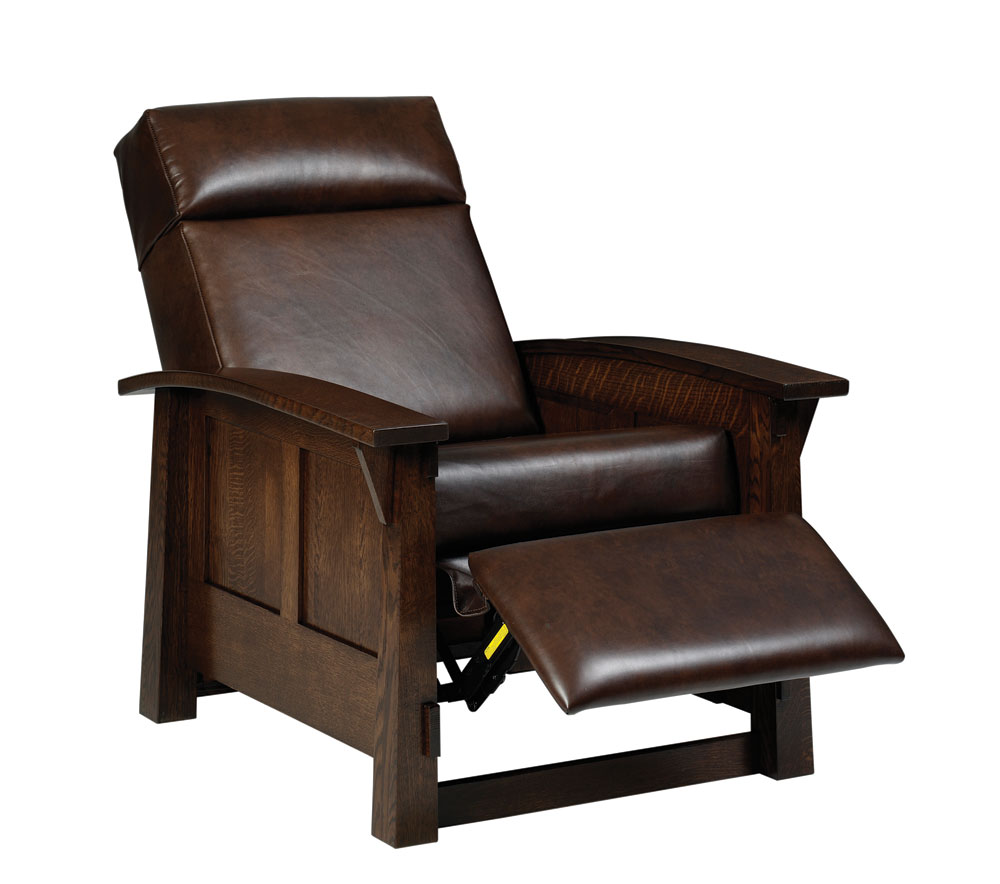
Stickley's leather recliners use premium hides selected for even grain and consistent thickness across the seat. Top-grain leather has had the outermost layer lightly sanded to remove imperfections. It is then coated with a pigment or finish to create a uniform color.
This makes it more stain-resistant than full-grain, but it sacrifices some breathability. It is still a solid choice for a high-use living room recliner. Both grades grow softer with age without losing structural integrity. That is a key distinction from lower grades.
Why Bonded and Faux Surfaces Fail Earlier
Bonded leather is made from scraps of real hide ground up, mixed with polyurethane, and pressed onto a fabric backing. It can peel and flake within two to three years because the bond between the composite layer and the backing breaks down under heat and friction.
Faux leather recliners use polyurethane (PU) or polyvinyl chloride (PVC) coated fabrics. PU versions feel softer and breathe slightly better than PVC. Neither develops a patina. Both tend to crack along seat creases where body heat concentrates.
If your budget limits you to faux leather, look for recliners that use PU rather than PVC. But understand that a faux leather recliner is a three-to-five-year piece, not a ten-year one.
How to Read Upholstery Claims Without Guessing
Retailers often use the term "genuine leather" as a quality signal, but in the leather grading system it actually sits below full-grain and top-grain. It refers to lower layers of the hide that have been heavily processed and coated.
Ask for the specific leather grade by name. If a salesperson cannot tell you whether the hide is full-grain or corrected, that should raise a concern. The leather wrapping your recliner matters, but the mechanism inside it controls how well it moves and how long it lasts.
Manual or Power: Matching the Mechanism to How You Sit
A manual recliner has fewer parts that can break, but a power recliner gives you precise position control at the touch of a button. Your choice depends on how often you recline, whether you need accessibility support, and how much maintenance you are willing to handle.
Manual Operation, Push-Back Designs, and Simpler Repairs
Manual recliners use a lever or handle connected to a steel linkage inside the chair. When you pull the handle, the footrest extends and the backrest tilts. These mechanisms have been refined over decades and rarely fail if the linkage is steel, not pot metal.
Push-back recliners skip the lever entirely. You lean back against the chair, and the backrest reclines through a spring-loaded hinge. Stickley's push-back manual recliners pair this design with clean arm profiles so the chair looks more like an accent piece than a traditional recliner.
This matters if your living room furniture favors a unified look. Repairs on manual recliners are straightforward. A worn spring or bent lever can be replaced without disassembling the electronics or ordering proprietary parts. That simplicity is a real advantage over the long run.
Power Recline, Position Control, and Everyday Convenience
Power recliners use a small electric motor, usually mounted under the seat, to control the backrest angle and footrest height independently. Better models add a power headrest that tilts forward for reading or watching a screen.
A wall-hugger power recliner uses a two-button panel tucked inside the arm and wall-hugging technology so the chair can recline just inches from the wall. Wall-hugger designs save roughly 12 to 18 inches of floor space compared to standard recliners.
- Position memory: Some power recliners store your preferred recline angle.
- Quiet motors: Look for models rated under 40 decibels during operation.
- Battery backup: A built-in battery lets you recline even during a power outage.
- USB ports: Handy for charging, but not a reason to choose one chair over another. Power mechanisms cost more to repair because they involve motors, wiring, and circuit boards. Ask whether replacement motors are available separately before you buy.
Lift Functions for Accessibility and Easier Standing
Power lift recliners tilt the entire seat forward and upward, bringing you to a near-standing position. This function is essential for anyone with limited knee or hip mobility. A power lift leather recliner combines the durability of real hide with a mechanism that makes daily use safer and more independent.
Look for lift recliners with a steel base frame and a motor rated for at least 300 pounds. Some models offer infinite-position recline. This means the backrest and footrest move independently to any angle.
Others use two or three preset positions. Lift recliners tend to be larger. Measure your room carefully and confirm the chair fits your body proportions. The next section explores this point in depth.
Comfort Features That Matter After the First Five Minutes
Seat depth and lumbar curve do more for long-term comfort than any built-in gadget. Getting the proportions right matters more than any add-on feature.
Seat Depth, Back Support, and Body Proportion
A recliner with a 21-inch seat depth fits most adults between 5'6" and 6'0" comfortably. If you are shorter, your feet may not touch the floor when sitting upright. If you are taller, your knees may extend past the seat cushion, causing pressure behind your thighs.
Lumbar support should match the natural curve of your lower spine. Some high-quality recliners build the curve into the foam itself. Others use an adjustable lumbar panel you can raise or lower. The second option accommodates more body types.
An oversized leather recliner with a wider seat and taller back works well for larger frames. Just confirm the wider seat does not reduce side bolster support. This is what keeps you from sliding sideways when you recline.
Swivel, Gliding, Rocking, and Space Planning
A swivel recliner rotates 360 degrees on a circular base. This is useful in open floor plans where you want to turn from a conversation area toward a screen or fireplace. A swivel leather recliner adds the durability of hide to that flexibility.
Rocker recliners add a gentle back-and-forth motion when the footrest is closed. A power swivel glider combines rotation, gliding, and powered recline in one chair. It requires more clearance than a standard recliner.
Consider your room layout before committing to a motion type. If your recliner will sit beside a sofa or loveseat, you need at least 6 inches of clearance on each side for safe operation. Swivel and glide features add function, but they also add parts that can wear.
Heat, Massage, and Other Add-Ons Worth Evaluating Carefully
Lumbar heating pads built into the backrest can soothe tight muscles, especially in cooler months. Look for recliners that use low-voltage heating elements with automatic shutoff timers. Massage functions range from basic vibration motors to rolling shiatsu nodes.
Budget massage recliners usually have coin-sized motors that buzz more than they massage. Higher-end models use targeted rollers that move along guided tracks in the backrest. Ask yourself whether you will actually use these features daily.
A heated leather recliner with a motor that fails after two years becomes a recliner with dead weight inside the cushion.
Prioritize the frame, the leather, and the recline mechanism first. Treat add-ons as bonuses, not decision drivers. If you want a recliner where the engineering speaks for itself, the Stressless line offers a different approach worth exploring.
Stressless by Ekornes Leather Grades and Fit Considerations
Stressless recliners are built in Sykkylven, Norway. Every model uses a patented glide system that adjusts automatically to your body weight. That single engineering detail eliminates the need for manual levers or preset positions.
How Stressless Leather Options Differ in Feel and Finish
Stressless offers multiple leather grades, each with a different level of surface treatment. Batick leather is lightly corrected with a soft, slightly textured finish. It resists staining well and comes in a wide range of colors.
Paloma leather is a thicker semi-aniline hide with a more natural grain and softer hand feel. Cori leather is the most protected option. It has a pigmented top coat that resists scratches, making it a practical choice for homes with pets or children.
Noblesse leather sits at the top of the range. It is a pure aniline hide with no pigment layer, so it shows the most natural markings and develops the richest patina over time. Choosing between these grades is not just about looks.
It is about how much wear and exposure the chair will face in your daily life. You can explore the full Stressless recliner collection at the Atlanta showroom.
Base, Size, and Support Choices for Different Rooms
Every Stressless recliner comes in at least two sizes, typically Small, Medium, and Large. The right size depends on your height and weight, not your room dimensions. A Medium fits most people between 5'5" and 5'11".
A Large is better above 6'0". Base options include the classic round wood base, a modern Star base with steel, and a flat Office base with wheels. The wood base is available in species like oak, walnut, and teak, each with a distinct grain and warmth.
The base finish should coordinate with other pieces in your living room or office. The Plus system, a spring-loaded mechanism in the seat and headrest, keeps your neck and lumbar supported as you shift position. It reacts to weight distribution, not buttons or levers.
When a Premium European Recliner Is Worth the Investment
A Stressless recliner costs more upfront than most domestic options. The value case rests on two things. The first is the patented glide mechanism, which has no motor to fail. The second is the leather quality, tanned in Europe under stricter environmental standards.
Stressless chairs are designed to last 20 to 30 years. The steel internal frame does not flex or fatigue the way wood frames can under constant gliding motion. Replacement parts, including cushions, armrest pads, and gas lifts, remain available for decades after purchase.
There are clear reasons the Stressless brand holds its value over time. If your priority is a living room recliner you never have to replace, the investment makes sense. But even premium recliners require evaluation before purchase. This brings up the practical question of how to judge value in person.
How to Judge Value Before You Buy
The most reliable way to judge a recliner's value is to ask specific questions about its mechanism, frame, and leather before you sit down. Vague answers usually signal vague construction.
Questions to Ask About Mechanisms, Including Leggett & Platt Mechanism Options
Leggett & Platt is one of the largest recliner mechanism manufacturers in the world. Their steel linkages and springs are used in recliners across a wide price range. Ask whether the mechanism is a Leggett & Platt unit or a proprietary alternative, and whether replacement parts are sold separately. Key questions to ask any retailer:
- What brand and model is the recline mechanism?
- Is the mechanism warranted separately from the frame?
- Can the motor or linkage be replaced without reupholstering?
- How many recline cycles is the mechanism rated for? A quality steel mechanism should be rated for at least 25,000 cycles. If the retailer cannot provide that number, ask for the manufacturer's spec sheet.
When a Budget Recliner Makes Sense and When It Does Not
A budget recliner in the $300 to $600 range can work for a guest room or a temporary setup. These chairs typically use pine or plywood frames, sinuous wire springs, and bonded or faux leather.
They serve a purpose when longevity is not the goal. For your primary seating, a budget recliner almost always costs more over time. Replacing a $400 chair every three years adds up faster than investing $1,500 to $3,000 once in a recliner with a kiln-dried hardwood frame and full-grain leather.
Seeing Leather Samples, Testing Support, and Making the Final Decision
Leather looks different under store lighting than it does in your home. Request a leather swatch to carry into natural light. Check how the color shifts between direct sun and shadow. Sit in the recliner for at least ten minutes.
Recline fully and notice whether the lumbar support holds steady or shifts. Stand up and check the seat cushion; quality foam should bounce back within a few seconds. Ask about the build timeline.
Custom leather recliners often require 14 to 16 weeks because the frame is built to order and the hide is cut from a single lot for color consistency. That wait is the cost of getting a piece made to your exact specifications. It is worth planning for.
Frequently Asked Questions
How Can I Tell Full-Grain Leather From Top-Grain?
Run your fingertip across the surface. Full-grain leather has visible pores and slight natural markings like healed scratches or insect bites. Top-grain feels smoother and more uniform because the surface has been sanded and coated. If the leather looks perfectly even with no variation, it is likely corrected or pigmented.
What Frame Construction Holds Up Best in a Recliner?
Kiln-dried hardwood frames using mortise-and-tenon joints and corner blocking offer the longest service life. The kiln-drying process removes moisture so the wood will not warp. Mortise-and-tenon joints resist the pulling force that reclining puts on the frame. Corner blocks add a third layer of stability at every stress point.
Which Recline Mechanisms Last Longest?
Steel mechanisms from established manufacturers like Leggett & Platt tend to outlast proprietary pot-metal alternatives. Before buying, ask for the cycle rating and confirm the mechanism can be replaced independently of the upholstery. Inspect the lever or motor housing for wobble, which signals loose mounting.
Power or Manual Recliner: Which Should I Choose?
A manual recliner has fewer failure points and costs less to repair. A power recliner offers quieter, more precise position control but depends on a motor and circuit board that may need replacement after 8 to 12 years. If you value simplicity, choose manual. If you need accessibility or fine adjustments, power is the better fit.
How Do I Keep Leather From Cracking or Peeling?
Ask whether the leather is aniline-dyed, semi-aniline, or pigment-finished, because each responds differently to sunlight and moisture. Aniline hides need conditioning every 6 to 12 months, while pigmented leathers are more forgiving. Always ask for the manufacturer's recommended care product to avoid using cleaners that strip the finish.
Which US Makers Build the Best Leather Recliners?
Stickley builds its upholstered and leather recliners in North Carolina using eight-way hand-knotted springs, kiln-dried hardwood frames, and premium hides. What sets American-made recliners apart is the ability to specify leather grade, frame finish, and cushion firmness at the time of order. Mass-produced imports rarely offer this.
Your Next Step Toward a Recliner Built to Last
Choosing a leather recliner is a decision you will live with every day. The frame joinery, leather grade, and mechanism quality covered in this guide give you a clear checklist for evaluating any chair you consider.
That holds whether it is a Stickley Mission recliner or a Stressless by Ekornes model with a Norwegian-built glide system.
If you are ready to compare leather samples under natural light and test the recline action in person, visit Mission Motif's Atlanta showroom. It carries both the full Stickley leather collection and the complete Stressless lineup.
Stop by 747 Miami Circle NE or call 404-370-1505 to talk through your options with someone who knows these pieces from the frame out. A design consultation can help you match the right leather, base, and size to your room and your daily routine, with no pressure and no rush.