
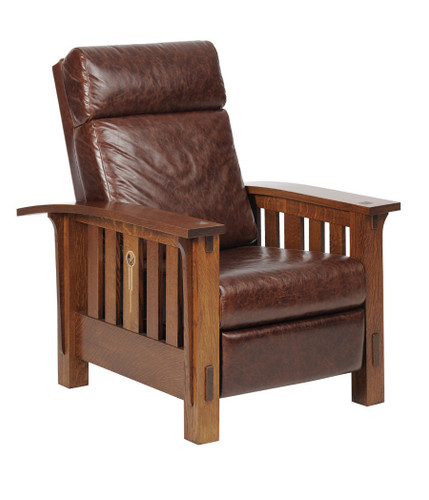
Morris Chair Living Room Styling: How to Balance Weight and Warmth
Posted by Mission Motif on Jun 9th 2026
So, you've picked out a Morris chair for your living room. Now comes the tricky part: how do you make it feel at home without letting it take over, or worse, look like it's waiting for a buyer in a showroom?
A solid Mission chair with broad arms, exposed tenons, and a reclining back never really blends in. It announces itself, and everything else in the room has to answer to it.
The truth is: most design conversations about Morris chairs start and end with the chair itself. The wood, stain, and upholstery aren't just details. They're the foundation. If you skip ahead to rugs and side tables before getting those right, you're probably setting yourself up for a headache later.
Here's what works in real homes: where you put the chair, what you put next to it, and how you balance its visual heft all matter. This guide walks through practical ways to place it, pair it, and style the area so it feels intentional, warm, and lived-in. By the end, you'll have a clear sense of what works, and what doesn't.
What Makes a Morris Chair Worth Building a Room Around
There's a reason people don't just tuck these chairs into a corner. A real Morris chair is more than just heavy-looking. Its construction and proportions shape the entire room.
Quartersawn White Oak, Ray Fleck, and Visual Character
Quartersawn white oak is the backbone of Arts and Crafts furniture. When oak is cut this way, those silvery flecks (medullary rays) pop out on the surface. It's not just for looks. This method takes more work but gives you wood that's stable, tight-grained, and less prone to warping.
The way quartersawn oak catches light changes throughout the day. In the morning, it glows golden. Under warm bulbs, the ray fleck can turn silvery-bronze. Your chair never looks quite the same twice, which adds a subtle richness to the space.
|
Wood Species |
Ray Fleck Visibility |
Grain Character |
Stain Absorption |
|---|---|---|---|
|
Quartersawn White Oak |
High, distinct silver |
Tight, closed |
Even and controlled |
|
Red Oak |
Low to moderate |
Open, coarse |
Uneven, blotchy risk |
|
Cherry |
None |
Smooth, fine |
Rich and consistent |
|
Brown Maple |
None |
Fine, subtle |
Very uniform |
You'll spot quartersawn white oak in the best Mission collections for a reason. Cherry and brown maple work too, if you want a warmer or cooler vibe.
Mortise-and-Tenon Construction and Exposed Tenon Details
On a well-built Morris chair, the joinery isn't hidden. Mortise-and-tenon joints, the rectangular tongue-and-socket connection, are right out in the open, with tenon caps left exposed on purpose.
It's a nod to the Arts and Crafts ideal that what's strong should also be beautiful. As the Arts and Crafts movement treated honest joinery as ornamental documents, Gustav Stickley built his work around that principle from the start.
These joints aren't just for show. They're sturdy, resisting the wear and tear of daily life far better than cheap shortcuts.
Exposed tenon caps draw your eye to the chair's geometry: horizontal and vertical lines that feel grounded and intentional. If you're picking out side tables or other pieces, echoing that joinery helps the whole room feel like it belongs together.
Once you've got a handle on what the chair brings to the table, it's time to figure out where it should actually go.
Choosing the Right Placement for Comfort and Presence
Where you put your Morris chair can make it the star or just another seat. Sightlines, traffic flow, and the chair's reclining space all matter.
Using the Chair as a Focal Point
Try angling the chair 15 to 30 degrees away from the main seating group. Suddenly, it feels like a destination, not an afterthought.
Set it by a window, fireplace, or built-in shelves for a natural backdrop. In bungalows or foursquares, the fireplace wall is a classic choice. The chair's vertical lines play well with the mantel's horizontal stretch, and firelight or sconces add warmth without washing out the wood's character.
Allowing Enough Space for Recline and Circulation
A reclining Morris chair eats up more space than you might think. Most need 18 to 24 inches behind them to fully recline, and at least 24 inches on each side for walking room.
Face the seat toward natural light, but not straight into it. And keep about 30 inches in front clear. No thick rugs to trip over when you kick back.
- 18 to 24 inches behind for full recline
- 24 inches on each side for walking space
- Seat faces toward, not into, natural light
- Footrest zone clear of chunky rugs
Once the chair's in the right spot, the challenge is making sure its visual weight doesn't tip the whole room off balance.
Balancing Visual Weight Without Losing the Craftsman Feel
A Morris chair in dark quartersawn oak is no shrinking violet. The trick isn't to hide it, but to keep the room from feeling too dense or heavy.
Pairing Strong Wood Forms With Lighter Upholstery
Upholstery is your best friend here. Warm leathers, think cognac or whiskey, reflect light and set off the wood's richness. Linen or cotton in oatmeal or terracotta also work, giving you softness without losing the craftsman edge.
Skip dark fabrics on a dark frame unless you've got plenty of daylight. Otherwise, it all just blurs together.
Cushion depth helps too. A thick, comfy seat and back cushion soften the chair's lines and make it more inviting. It's a sweet spot between strict minimalism and puffy, overstuffed sofas.
Using Negative Space, Window Light, and Wall Tone
Negative space is underrated. Let the area around and above the chair breathe. A single framed print or a bit of metalwork is usually enough. Skip the gallery walls behind it; they just muddy the chair's strong lines.
Wall color matters more than you'd think. Warm sage, muted ochre, olive, or dusty terracotta all play nicely with fumed or medium-stained oak.
Super pale grays or icy blues can overemphasize the wood's warmth and make the chair feel heavier. Picking wall color with your wood tone in mind ties things together way better than treating them as totally separate choices.
With the chair in place and the weight balanced, it's time to pick what actually sits next to it.
Pairing Companion Pieces That Belong With the Chair
The best Mission living room furniture echoes the chair's construction without copying it exactly. You want everything to feel related, not like a matched set.
Side Tables With Honest Joinery and Useful Scale
A Mission side table should line up with or just below the arm, usually 24 to 27 inches high. Too low and it's awkward; too tall and it blocks the clean line of the arm.
An 18 to 22 inch top gives you space for a lamp and a book without crowding. Look for tables with visible joinery: through-tenon stretchers, pegged joints, or corbeled brackets. Butt joints or fussy moldings just don't feel right next to a Morris chair.
Craftsman Lighting, Throw Textiles, and Functional Layers
Lighting makes a big difference. Mica-shade floor lamps or hammered-copper table lamps give off a warm glow that flatters quartersawn oak. Cool-white LEDs wash out the wood's warmth.
For throws, medium-weight wool or blends in earth tones or classic Arts and Crafts patterns add coziness without clutter. Drape it over the back or arm, not piled in the seat. It's a small touch, but it signals that the chair actually gets used.
- Lighting: Mica-shade or hammered-metal lamp
- Throw: Wool or blend in terracotta, ochre, green, or charcoal
- Tray: Small hammered-copper or Mission-style oak tray
- Books or ceramics: One or two, not a whole collection
With the chair and its neighbors sorted, let's look down. Rugs are next.
Grounding the Seating Area With Rugs and Color Palette
A rug under your Morris chair area does double duty: it marks the zone and adds pattern and texture that can either fight with or flatter the chair's lines.
Rug Size, Placement, and Border Visibility
If you're grouping the chair with a sofa or settee, an 8x10 rug is usually the minimum. Front legs of every seat on the rug, ideally all four for the Morris chair. That way, the chair feels anchored, not like it's floating.
Hand-knotted Arts and Crafts rugs with organic motifs, subtle geometric fields, and natural dye variation just work. The little irregularities in a real rug play well with the handmade vibe of Mission furniture.
Machine-made rugs with perfect repeats tend to feel a bit flat next to the real thing.
Wood Species and Finish Choices for Different Room Colors
The finish on your Morris chair's oak frame ties everything together: the wall colors, the rug, the whole palette. Here's a quick cheat sheet:
|
Finish Tone |
Works With |
Avoid |
|---|---|---|
|
Fumed/Dark Mission |
Warm sage, ochre, terracotta, charcoal |
Cool grays, ice blue, bright white |
|
Medium Honey Oak |
Warm cream, dusty green, sand, rust |
Jewel tones, very dark walls |
|
Cherry (Red-Brown) |
Soft gold, warm white, burgundy, forest |
Cool blue-gray, stark contrast |
|
Light/Natural |
Almost any warm palette |
Flat cool neutrals |
If you're local, it's worth seeing stain samples and fabric swatches in person. Photos just don't do the colors justice.
Once your palette and rug are dialed in, it's about making the room feel like it was meant to grow and change with you, not just look good for a moment.
Styling for a Room That Will Age Well
A room centered on a Morris chair should get more comfortable and personal as time goes by, not stale or stuck in a trend. That means picking larger pieces that genuinely belong with the chair and leaving space for your own story to show up.
Mixing the Chair With Sofas, Bookcases, and Case Pieces
A Morris chair feels right alongside a Mission-style sofa or settee with similar frame proportions: flat arms at about the same height, visible structure, and upholstery that complements but doesn't copy.
If the sofa's arms sit much higher or lower than the chair's, the mix ends up looking off rather than intentional.
Bookcases and case pieces with through-tenon construction, vertical slats, and simple inset doors echo the room's style without repeating the chair. Stickley's Mission line uses quartersawn white oak and the same joinery tradition as their seating, making it easier to mix pieces from the same construction lineage.
When to Refine Details in Person Before You Commit
Photos and swatches get you close, but they can't show how a stain shifts in your actual light, how a certain leather grade feels after you've sat for a bit, or whether the chair's seat depth actually fits you.
These little details decide if a piece becomes a favorite or just gets shuffled to a spare room.
If you're putting together a craftsman home and want furniture built to last, Mission Motif's design team can walk you through options in person. Swing by the showroom at 747 Miami Circle NE in Atlanta, or call 404-370-1505 to compare wood species, stains, and fabrics before making a choice.
Frequently Asked Questions
Here are the questions that tend to come up most as people pick their Morris chair and work out the rest of the room.
What Wood Species and Grain Cuts Best Complement a Craftsman Living Room When Choosing a Reclining Armchair?
Quartersawn white oak is the classic pick for Arts and Crafts rooms. Its ray fleck and tight grain really stand out, and it takes stain beautifully. If you lean warmer or more neutral, cherry and brown maple are solid bets too.
How Should I Balance a Recliner's Visual Weight With a Sofa, Settee, or Built-In Bench in the Same Seating Group?
Try to match arm heights and pick a sofa with a similar frame heft. An oversized, puffy sofa right next to a Mission Morris chair just feels mismatched. Stick with pieces that share the same general proportions, even if they're not from the same line.
Which Upholstery Leathers and Fabrics Hold Up Well While Staying True to Arts and Crafts Palettes and Textures?
Top-grain leather in shades like cognac, saddle, or dark chestnut is tough and fits the Mission look. For fabric, tightly woven linen-cotton blends in earth tones or wool upholstery in simple weaves both feel right and wear well. Steer clear of shiny or synthetic-heavy fabrics. They just don't suit the vibe.
What Side Table Height and Lamp Placement Work Best With a Chair That Reclines and Has Broad Arms?
A side table between 24 and 27 inches tall usually lines up with the arm rail, making it easy to reach things. For lamps, aim to have the bottom of the shade at your seated eye level, about 40 to 42 inches from the floor.
How Much Clearance Should I Allow Behind and Beside the Chair So the Back Adjusts Without Crowding Walkways?
Leave 18 to 24 inches behind the chair when it's fully reclined, and about 24 inches on each side for walking space. That way, the chair works smoothly and the room doesn't feel squeezed.
What Rug Size and Pattern Scale Help Anchor the Seating Area Without Fighting the Chair's Strong Vertical and Horizontal Lines?
An 8x10 or 9x12 rug with a traditional Arts and Crafts border and a low-to-medium pile usually grounds the space nicely. Go for patterns with a small or medium repeat. Big medallions just compete with the chair's shape, but geometric borders and field patterns play along well.